
If you are searching for federal lawyers in Coral Gables, one practical question may be where a federal case connected to the area is actually handled. The answer depends on the federal district and division, the alleged conduct, and the documents filed in the case. A person’s home or the place where agents made contact does not, by itself, answer every venue question.
How federal lawyers in Coral Gables assess the Miami Division
Coral Gables is in Miami-Dade County. The U.S. District Court for the Southern District of Florida identifies Miami-Dade County with its Miami Division. The court lists its Miami courthouses in downtown Miami, including the Wilkie D. Ferguson, Jr. U.S. Courthouse at 400 North Miami Avenue. That helps explain why a federal matter connected to Coral Gables may involve proceedings in Miami, even though the investigation or a person’s home is in Coral Gables.
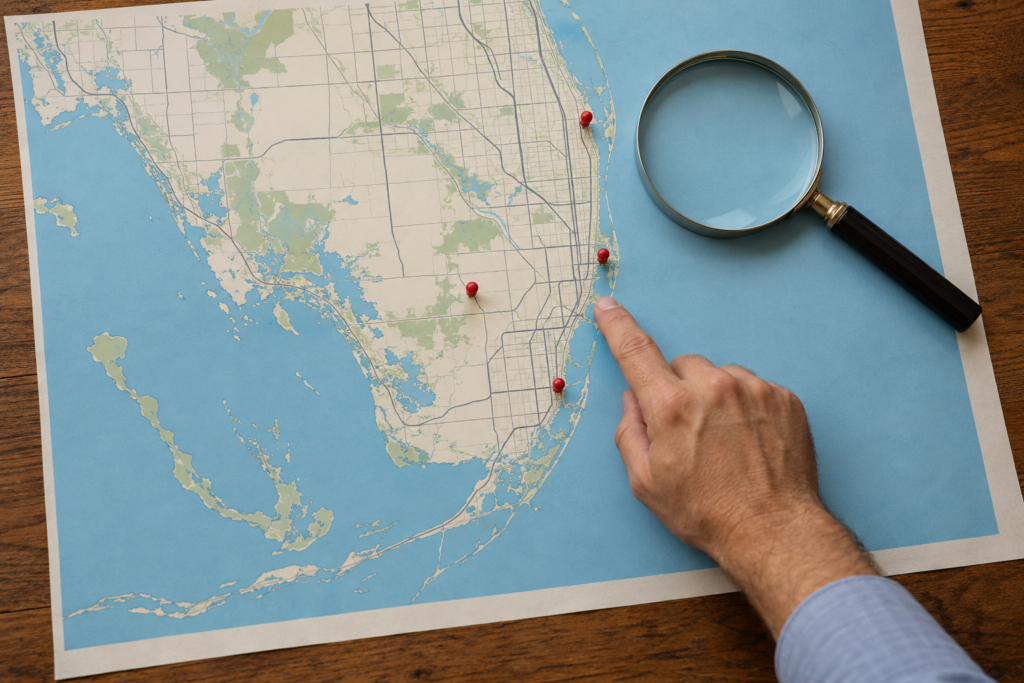
The district court’s Southern District map shows the county-to-division outline. The court’s Miami Courthouses page provides current public location information. A courthouse address is useful context, but it does not determine where a particular case is assigned or where every hearing will take place.
The U.S. Attorney’s Office for the Southern District of Florida is a separate office from the court. Its public information identifies Miami as the main office and lists staffed branch offices elsewhere in the district. Prosecutor office locations and court locations answer different questions.
Venue follows the alleged conduct and applicable law
Federal criminal venue is a legal question about the place where an offense may be prosecuted. Federal Rule of Criminal Procedure 18 generally directs prosecution to a district where the offense was committed. It also instructs the court to set the trial location within the district with due regard for the convenience of the defendant, any victim, and witnesses, as well as the prompt administration of justice. Read the current Federal Rules of Criminal Procedure for the rule’s text.
Some allegations involve conduct in more than one district or continuing activity. Congress has addressed certain multi-district and continuing offenses in 18 U.S.C. § 3237. Whether a particular statute applies, and what facts matter, depends on the charge. It is not safe to infer venue from an investigation’s label, an agent’s office, a search location, or where a person was first contacted.
For a case tied to Miami-Dade County, the division map provides a useful starting point. The charging instrument, governing statute, alleged acts, and court assignment provide more specific information. A lawyer should review the actual docket and filings before drawing conclusions about a case’s district, division, or trial location.
What the paperwork can tell you
Early federal contacts do not all mean the same thing. A subpoena, target letter, complaint, indictment, warrant, and court notice serve different purposes. Some are issued before a criminal case appears on a public court docket. Others identify a court, case number, judge, response deadline, hearing, or required appearance. The document itself and its method of service matter.
Keep the original documents and envelopes. Note when and how each was received. Do not write on, alter, delete, or forward potentially relevant records without considering confidentiality and legal advice. If there is a court notice, preserve the case number, date, time, location, and any filing or appearance instructions. A notice may refer to a particular courthouse or courtroom; confirm logistical details using official court information.
An investigation is not the same as a filed case
A federal agency’s inquiry and a court prosecution are different stages. Someone may receive a request for records or an interview before prosecutors file charges. A public docket search may not reveal every investigation, and the absence of a docket entry does not establish that no inquiry exists. Conversely, a government contact by itself does not establish that a person has been charged or that a prosecution will follow.
That distinction matters when deciding what information to share and which deadlines apply. A subpoena can carry a response date even if no indictment is on file. A summons or court order may require a different response. Do not treat a request from an investigator as interchangeable with a filed court notice. Counsel can identify who issued the document, what legal authority it cites, what it requires, and whether the deadline calls for action. If the document is unclear, preserve it and get advice promptly rather than guessing about its effect.
Questions counsel may examine
When evaluating a location or venue issue, counsel may compare the charging allegations with the statute, dates, communications, transactions, witnesses, and records identified in the case. For conduct spanning locations, a careful timeline can help distinguish where separate acts allegedly occurred from where they were coordinated, received, or discovered. The significance of any one location depends on the offense charged and the evidence the government intends to use.
Venue is only one part of a federal defense. The review may also address the elements of each charge, the source and handling of evidence, statements, search or seizure issues, deadlines, and conditions of release. Those questions require a case-specific analysis; no single map or fact about residence resolves them.
Finding federal defense counsel for a Coral Gables matter
People looking for federal lawyers in Coral Gables may want to ask how counsel will identify the charging court, verify dates and deadlines, and explain the next procedural steps. Bring any subpoena, target letter, indictment, warrant, release paperwork, or court notice you received. Do not assume an inquiry has ended because no arrest has occurred, and do not miss a stated deadline while waiting for clarification.
Beaton Law Firm’s federal criminal defense practice provides information about the firm’s federal defense services. A consultation can help identify what documents and dates need prompt attention. The appropriate next step depends on the facts and procedural posture of the matter.
General information
This article offers general information about federal venue and the Southern District of Florida. It is not legal advice and does not assess any individual case. Federal rules and court assignments can change. Consult a lawyer about current court filings, deadlines, and the law applicable to your circumstances.