
Attorney and client reviewing a federal target letter in a private office

Federal Target Letter: What It Means and What to Do Next


A federal target letter is a formal warning that prosecutors consider a person a target of a federal grand jury investigation. It is not an indictment, an arrest warrant, or a finding of guilt. It does mean the investigation has reached a serious stage and that decisions about records, interviews, testimony, and communications should be made carefully.

Anyone who receives a target letter should keep the complete letter and envelope, note every deadline, preserve potentially relevant information, and speak with federal criminal defense counsel before contacting agents or prosecutors. The right response depends on the investigation, the evidence, and the recipient’s role.

What “Target” Means in a Federal Investigation

The Department of Justice’s Justice Manual defines a target as a person whom the prosecutor or grand jury has substantial evidence linking to a crime and whom the prosecutor views as a potential defendant. The manual distinguishes a target from a subject, whose conduct is within the scope of the investigation, and from a witness who may simply have relevant information.

Those labels are important, but they are not permanent guarantees. The government’s view may change as it gathers documents, interviews witnesses, analyzes digital evidence, or hears grand jury testimony. A target letter should therefore be evaluated as part of the larger investigation rather than read in isolation.

A Target Letter Is Not the Same as a Subpoena

A target letter usually communicates the recipient’s status and may identify the general subject of the investigation. It may also invite the recipient to meet with prosecutors or request an opportunity to testify. A subpoena, by contrast, is a legal demand for testimony, documents, or both. A person can receive one without the other, and the obligations created by each document are different.

Do not assume that an invitation to meet is routine or that appearing before the grand jury is automatically helpful. The Justice Manual explains that a prosecutor ordinarily should consider a reasonable request by a target or subject to testify when specified conditions are met, but grand jury testimony is under oath and can create significant risk. Whether to seek a meeting or offer testimony requires a fact-specific assessment.

Preserve Records Without Altering Them

Once a person knows of a federal investigation, relevant information should be preserved. Depending on the matter, that may include email, text messages, cloud files, financial records, contracts, calendars, photographs, access logs, accounting data, and business records. Organizations may also need to identify employees or vendors who control relevant information and suspend routine deletion practices.

Preservation does not mean rewriting, reorganizing, or “cleaning up” the evidence. Do not delete communications, backdate documents, replace original files, or ask others to change their accounts. Keep the target letter and its attachments intact. Counsel can help define a defensible preservation process and separate responsive material from unrelated or privileged information.

Organized digital devices and records preserved for a federal investigation
Preserving original records and documenting where they came from can help counsel reconstruct the facts accurately.

Avoid Unplanned Interviews and Public Explanations

A person who wants to correct the record may feel pressure to call an agent, prosecutor, colleague, or potential witness immediately. That can make the situation harder. An incomplete memory, an estimate presented as fact, or a statement that conflicts with an existing record may become evidence in its own right. Public posts and internal workplace messages can create similar problems.

Before answering substantive questions, identify who is asking, the agency involved, the stated purpose of the contact, and whether counsel can participate. Do not lie, conceal records, or interfere with another person’s account. It is possible to preserve rights and respond lawfully without improvising an explanation before the evidence has been reviewed.

Review the Government’s Likely Theory

A useful defense review starts with the statutes or conduct mentioned in the letter, the relevant time period, the agencies involved, and any earlier subpoenas, warrants, audits, or interviews. Counsel may compare the government’s apparent theory with the underlying documents and identify what evidence bears on knowledge, intent, identity, participation, or loss.

In a financial or business investigation, for example, the meaning of a transaction may depend on contracts, approval chains, accounting practices, professional advice, and who had access to particular systems. In a communications-based case, context and authorship may matter as much as an isolated message. A careful chronology helps distinguish established facts from assumptions and identifies records that should be located promptly.

Consider Privilege and Separate Interests

Target letters involving a business can create difficult questions about who a lawyer represents. Counsel for the company may not represent an employee, officer, or owner personally. People whose interests appear aligned at the beginning of an investigation may later have different legal positions. The existence and scope of attorney-client privilege also depend on the purpose, participants, and handling of a communication.

Before sharing legal advice, internal reports, or communications with third parties, obtain guidance about privilege and confidentiality. When records belong to an employer or another organization, do not remove them without authorization. Counsel can pursue lawful methods of preserving and reviewing information while respecting ownership and privacy obligations.
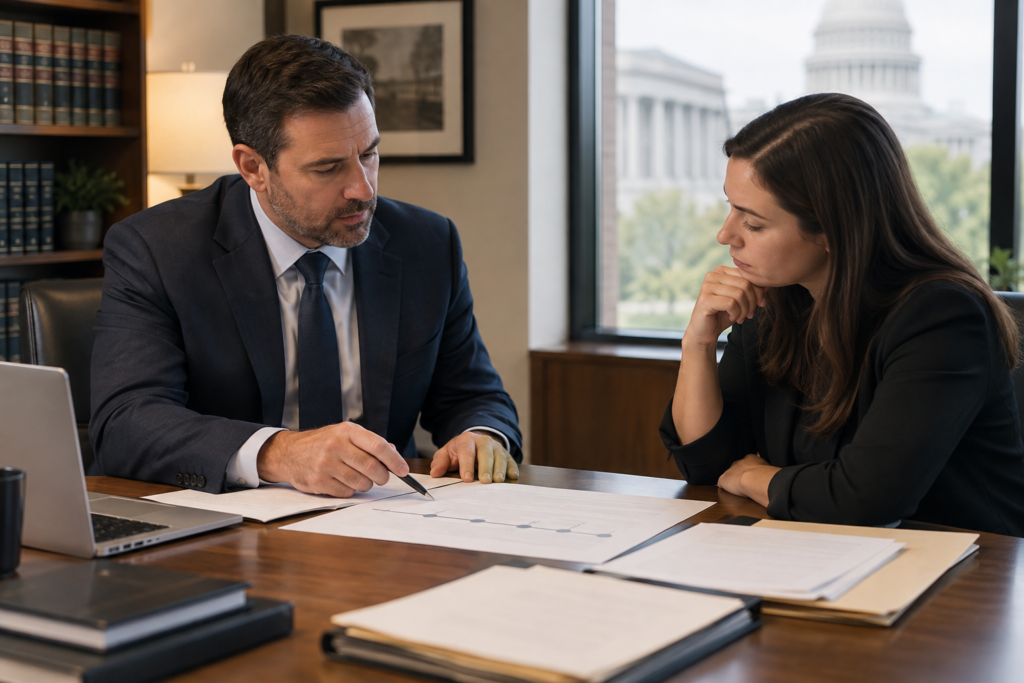
Defense attorney and client reviewing the timeline of a federal investigation
A focused review can separate confirmed facts from assumptions before decisions are made about interviews or testimony.

Possible Responses to a Federal Target Letter

There is no single correct response to every target letter. Depending on the circumstances, counsel may contact the prosecutor to confirm status, clarify deadlines, learn the general scope of the investigation, address a related subpoena, present documents, request a meeting, or advise against voluntary testimony. In some matters, counsel may submit a focused explanation supported by reliable records. In others, making a presentation before the evidence is understood would be unwise.

The Department of Justice’s public guidance on target letters notes that letters are not required in every case. A person may therefore be under investigation without receiving one. Conversely, receiving a letter does not establish that an indictment will occur. It signals a need for an informed strategy, not a guaranteed outcome.

How Federal Defense Counsel Can Help

Beaton Law Firm’s federal criminal defense practice handles investigations and prosecutions involving federal agencies and grand juries. Counsel can evaluate the letter, preserve evidence, communicate with the government when appropriate, and advise on interviews, document productions, presentations, and potential charges. When an investigation concerns financial transactions, the firm’s money laundering defense practice may also be relevant to the issues under review.

Early involvement does not promise that charges will be avoided. It can help prevent avoidable mistakes, protect privileged communications, and ensure that decisions are based on the actual record. A target letter should be treated as time-sensitive even when it does not state an immediate court date.

Sources and Further Reading

This article is for general information only and is not legal advice. The facts and law in an individual investigation may differ, and no attorney-client relationship is created by reading this article or contacting the firm.

Attorney and healthcare professional preparing a Medicare fraud investigation

Medicare Fraud Charges: Federal Defense Considerations


Medicare fraud charges can put a provider, business owner, executive, or other professional in the middle of a federal investigation. These matters may involve billing records, patient files, electronic health records, referral arrangements, interviews, audits, and data analysis. A billing irregularity is not automatically a criminal offense, but an investigation should be taken seriously from the beginning.

The right response is fact-specific. Defense counsel should identify what the government is alleging, preserve the relevant records, understand the organization’s billing and compliance process, and evaluate both criminal and civil exposure before making strategic decisions.

What Can Lead to a Medicare Fraud Investigation?

Federal healthcare investigations can arise from many different theories. The allegations may involve claims for services that were not provided, services said to be medically unnecessary, inaccurate coding, upcoding, unbundling, improper referrals, kickbacks, false documentation, or the use of another person’s provider information. The Department of Justice describes healthcare fraud enforcement as including matters involving Medicare and other federal healthcare programs, while the HHS Office of Inspector General publishes compliance resources addressing federal fraud and abuse laws.

These categories are not conclusions about any particular provider. The important question is what happened, who made the relevant decision, what information was available at the time, and whether the evidence supports the mental state required for the specific offense being investigated.

Separate a Billing Error From an Alleged Criminal Scheme

Healthcare billing is complex, and mistakes can occur because of coding changes, software problems, incomplete records, training gaps, or a misunderstanding between a provider and a billing company. A defense review should not assume that every questionable claim reflects intentional conduct. It should examine the actual workflow: who selected the code, who reviewed the claim, what documentation existed, whether the practice relied on outside advice, and whether concerns were corrected when discovered.

At the same time, a person should not dismiss repeated notices, audit findings, unusual referral arrangements, or requests for records. Those events may become important evidence about knowledge, intent, notice, or the organization’s response. A careful timeline can help separate an isolated mistake from the government’s theory of a continuing scheme.

Attorney and healthcare professional reviewing anonymized billing evidence
Reviewing billing workflows and supporting records can help clarify what was submitted, who handled it, and what the documentation shows.

Preserve Billing, Clinical, and Communications Records

Once an investigation is suspected, relevant information should be preserved. That may include claims data, superbills, encounter notes, electronic health records, coding policies, contracts, referral records, emails, text messages, training materials, audit reports, corrected claims, and communications with vendors. Records should be collected in a way that preserves their context and authenticity.

Do not delete, alter, backdate, or selectively recreate records. Do not ask employees to coordinate stories or speculate about what investigators want to hear. Counsel can help establish a preservation process, identify custodians, and organize the materials so the facts can be assessed accurately.

Respond Carefully to Audits, Subpoenas, and Interviews

An audit, civil investigative demand, subpoena, or request for an interview does not by itself prove that criminal charges will follow. It does mean that the response should be deliberate. Before producing information, counsel may need to determine the scope of the request, identify responsive records, protect privileged material, and address technical or privacy issues involving patient information.

Anyone asked to participate in an interview should understand the setting and their rights before answering questions. Guessing, filling gaps, or giving an unprepared explanation can create avoidable inconsistencies. A healthcare professional should also avoid obstructing an investigation or interfering with records. The goal is an accurate, lawful, and organized response based on the actual evidence.

Examine the Government’s Evidence and Methods

Federal healthcare cases may rely on large claim datasets, statistical comparisons, expert opinions, cooperating witnesses, emails, financial records, and testimony from billing or clinical personnel. Defense counsel should test how the information was collected, whether the data is complete, whether the comparison is fair, and whether the records support the conclusions being drawn.

Other issues may include the scope of a subpoena or warrant, the way electronic evidence was obtained, authentication, hearsay, expert methodology, and whether a document or statement is admissible. The Federal Rules of Criminal Procedure provide the framework for federal criminal proceedings, but the application of those rules depends on the facts and stage of the matter.

Consider Criminal, Civil, and Administrative Consequences

Medicare-related allegations can create more than one type of risk. A matter may involve potential criminal charges, civil claims under the False Claims Act, repayment demands, professional licensing concerns, or exclusion from federal healthcare programs. Those consequences are related but not identical. A person or organization should understand which agency is involved, what theory is being asserted, and what deadlines apply before choosing a response.

The HHS OIG explains that federal fraud-and-abuse laws can include the False Claims Act, Anti-Kickback Statute, physician self-referral law, exclusion authorities, and civil monetary penalty provisions. The specific statute and factual theory matter. A broad label such as “Medicare fraud” does not answer the legal questions in an individual case.

Attorney and healthcare executive preparing an investigation timeline
A focused consultation can help organize the investigation timeline, identify decision points, and determine what requires immediate attention.

How Federal Defense Counsel Can Help

A federal healthcare defense lawyer can help evaluate the allegations, preserve evidence, communicate with investigators when appropriate, coordinate technical or coding experts, and develop a response that reflects the actual record. Beaton Law Firm’s healthcare fraud defense practice addresses allegations involving healthcare billing and federal programs. Counsel may also coordinate the broader strategy with the firm’s federal criminal defense practice when a matter may lead to federal charges.

Early advice does not guarantee a particular result. It can, however, help prevent avoidable mistakes, preserve important evidence, and clarify the choices available as the investigation develops. Anyone who receives a subpoena, audit request, target letter, search warrant, or interview request should obtain advice promptly and avoid discussing the matter publicly.

Sources and Further Reading

This article is for general information only and is not legal advice. The facts and law in an individual investigation may differ, and no attorney-client relationship is created by reading this article or contacting the firm.

Aggravated Assault With a Deadly Weapon in Florida

Aggravated Assault With a Deadly Weapon in Florida: Potential Jail Time and Penalties


What Florida Law Defines as Aggravated Assault

To understand the charge you’re facing, you need to understand exactly what prosecutors must prove.

Under Fla. Stat. § 784.011, assault means an intentional, unlawful threat to commit violence against another person, coupled with the apparent ability to carry it out, that creates a well-founded fear of imminent harm in the victim. No physical contact is required. A threat alone, if credible and immediate, satisfies the definition.

Assault and battery are related but distinct. Battery involves actual physical contact. Assault does not. When people use the phrase “assault and battery,” they often mean both happened, but the charge you’re facing here is assault, specifically in its most serious form.

Under Fla. Stat. § 784.021, aggravated assault in Florida occurs when an assault is committed either with a deadly weapon, or with the intent to commit a felony. The presence of a deadly weapon, a firearm, a knife, a vehicle used as a weapon, or any object capable of causing death or serious bodily harm, elevates a basic threat into a felony charge.

When the prosecution also alleges an intent to kill, they are asserting the most aggravated version of this charge available under Florida statute. That intent is rarely proven through a direct statement. Prosecutors typically infer it from the circumstances: the type of weapon used, the manner of the threat, the words spoken, the victim’s proximity, and any history between the parties.

That inference is also where the defense has room to work.

Penalties for Aggravated Assault With Intent to Kill in Florida

Aggravated assault is classified as a third-degree felony under Florida law. Under Fla. Stat. § 775.082, a third-degree felony carries a maximum sentence of five years in prison, up to five years of probation, and a fine of up to $5,000.

Those are the statutory maximums for the base charge. In practice, sentencing for aggravated assault in Florida can look very different depending on several factors.

A Firearm Changes the Sentencing Calculation

If the deadly weapon involved was a firearm, the sentencing exposure increases significantly. Under Fla. Stat. § 775.087, Florida law reclassifies felonies upward when a firearm is used, displayed, or possessed during the commission of the offense, and imposes mandatory minimum prison terms for specific firearm-related felonies. This means a judge may have limited discretion to impose a lighter sentence, regardless of the circumstances.

The difference between a weapon and a firearm matters enormously at sentencing. If your case involves a gun, the mandatory minimum provisions under § 775.087 need to be analyzed carefully.

Prior Felony Convictions Can Multiply the Consequences

Florida law treats repeat offenders differently. Under Fla. Stat. § 775.084, defendants with prior felony convictions can be designated as habitual felony offenders or habitual violent felony offenders, which triggers enhanced sentencing, including mandatory minimum terms and, in some cases, the possibility of life imprisonment for subsequent offenses. The statute also defines violent career criminals and three-time violent felony offenders, each carrying its own sentencing framework.

If you have prior felony convictions on your record, the base penalties for the current charge are not the full picture.

The Victim’s Identity Can Escalate the Charge

Florida law provides enhanced penalties when the victim of certain violent offenses is a protected professional, including law enforcement officers, firefighters, emergency responders, and school personnel. If your charge involves one of these victims, the felony classification and corresponding punishment can be elevated above the standard third-degree felony framework.

The Long-Term Consequences Extend Beyond Prison

A felony conviction in Florida carries consequences that outlast any prison sentence. You lose the right to vote while incarcerated and on supervision. You lose the right to possess a firearm. Employment in many licensed professions becomes unavailable. Housing applications, professional licenses, and federal benefits can all be affected. For non-citizens, a felony conviction can trigger immigration consequences including deportation.

These are not abstract risks. They are outcomes that attach automatically to a conviction and shape daily life for years.

Florida Defenses That Can Be Raised Against This Charge

Facing felony charges does not mean a conviction is inevitable. Florida law recognizes specific defenses to aggravated assault charges, and a skilled attorney will examine your case for each one.

Self-Defense Under Florida’s Justifiable Use of Force Statute

Florida’s self-defense law is among the most defendant-protective in the country. Under Fla. Stat. § 776.012, a person may use or threaten force, including deadly force, when they reasonably believe it is necessary to prevent imminent death, great bodily harm, or the commission of a forcible felony against themselves or another person. Crucially, the statute imposes no duty to retreat when a person is lawfully present at the location.

If you believed you were about to be killed or seriously harmed, and your response was proportionate to that threat, self-defense may be a viable and powerful defense to the charge, and you can contact a self-defense attorney.

Challenging the Intent to Kill Element

“Intent to kill” is not self-proving. Prosecutors reconstruct it from circumstantial evidence. A skilled defense attorney will scrutinize how that intent is being inferred: the witness accounts that describe it, the forensic evidence offered to support it, the statements attributed to you, and whether any alternative interpretation of the events is more consistent with the facts.

If the evidence of intent to kill is thin, contradictory, or based entirely on the alleged victim’s account, that element of the charge can be contested directly at trial.

Inability to Carry Out the Threat

Florida’s assault definition requires the apparent ability to carry out the threat. If the circumstances show you lacked the actual ability to immediately follow through, the foundational element of the charge is weakened. This is not always available as a defense, but it is one a competent attorney will evaluate based on the specific facts.

Conditional or Non-Imminent Threats

Assault requires the creation of fear of imminent violence. A threat that is conditional (“if you do X, I will hurt you”) or was made in a context where no immediate harm was possible may not satisfy the legal definition. Whether this applies depends on exactly how and when the alleged threat was made.

What a Florida Criminal Defense Attorney Can Do for You

The felony charges you’re facing carry penalties that are difficult to fully grasp from a search result alone. The exact exposure depends on your criminal history, the specific weapon involved, the identity of the alleged victim, the evidence the state has collected, and how Florida’s sentencing scoresheet calculates a recommended range for your case.

A Florida criminal defense attorney works through each of these variables before the case ever reaches a courtroom. That means reviewing the arrest report and any witness statements, identifying whether the search, stop, or arrest was conducted lawfully, examining what evidence the prosecution actually has to prove intent to kill, evaluating whether a firearm mandatory minimum applies and whether it can be challenged, and determining whether a plea negotiation or trial gives you the best outcome.

These are not generic tasks. Florida’s criminal statutes and sentencing guidelines are specific, and the procedures in Miami-Dade County courts have their own rhythms. An attorney who handles serious felony cases in this jurisdiction understands both the law on paper and how it plays out in practice.

The stakes on a charge like this are too high to navigate without someone who knows this terrain.

Frequently Asked Questions

Is assault with a deadly weapon with intent to kill always a felony in Florida?

Yes. Under Florida law, aggravated assault is a third-degree felony. Depending on the weapon involved or the defendant’s prior record, the charge can carry enhanced penalties beyond the standard third-degree felony framework.

What is the maximum prison sentence for aggravated assault in Florida?

The base maximum for a third-degree felony is five years in prison under Fla. Stat. § 775.082. That ceiling rises if a firearm was used, if the defendant qualifies as a habitual offender, or if other aggravating factors apply.

Can I go to prison even if no one was physically hurt?

Yes. Assault does not require physical contact. The charge is based on the threat and the fear it created in the victim. A conviction can result in a prison sentence even without any physical harm to the other person.

What happens if I have a prior felony conviction?

Prior convictions can trigger habitual offender designations under Fla. Stat. § 775.084, which carry mandatory minimum sentences and can significantly increase the maximum penalty you face. An attorney needs to analyze your full record to assess this exposure accurately.

How does self-defense work in Florida?

Florida’s self-defense law allows the use of force, including deadly force, when a person reasonably believes they face imminent death or serious bodily harm, and does not require the person to retreat if they are lawfully present at the location. Whether self-defense applies in your specific case depends on the facts and requires a careful review of the evidence.

Should I speak to the police before hiring an attorney?

No. You have the right to remain silent, and anything you say can and will be used against you. Contact a criminal defense attorney before making any statements to law enforcement.

Schedule Your Free Consultation With Beaton Law Firm

If you are facing aggravated assault with a deadly weapon charges in Florida, every decision you make from this point forward carries weight. Talking to law enforcement without counsel, missing a court date, or waiting too long to build a defense can all have serious consequences.

The first step is a conversation with an attorney who handles serious felony charges in Florida courts. That consultation is free, and it gives you a clear picture of your situation, your options, and what a defense actually looks like in your case.

Schedule your free consultation now.

This content is provided for informational purposes only and does not constitute legal advice. Laws and their application vary by individual circumstance. You should consult a qualified Florida criminal defense attorney for advice specific to your situation.

Defense attorney reviewing a federal criminal case in a courthouse conference room

Fighting Federal Criminal Charges: Key Defense Steps


Fighting federal criminal charges requires a defense plan built around the evidence, the charging document, and the rules that govern federal court. Federal cases often involve extensive records, multiple agencies, electronic evidence, and deadlines that arrive quickly. A person who has been charged, subpoenaed, searched, or contacted by investigators should understand what is happening before making decisions that could affect the case.

There is no single defense that applies to every federal prosecution. The right approach may involve challenging the government’s evidence, contesting a search, examining the elements of the offense, negotiating a resolution, or preparing for trial. Early review helps identify which issues actually matter and prevents the case from being guided by assumptions.

Start With the Exact Federal Charge

The first step is to identify the statute, count, alleged dates, and conduct described in the indictment or complaint. A broad description such as fraud, conspiracy, or trafficking does not reveal every issue. The government must prove the elements of each charged offense beyond a reasonable doubt, and the defense should test whether the allegations and evidence address each required element.

The Department of Justice’s overview of federal charging explains how federal prosecutors use charging documents and grand-jury proceedings. That overview is useful background, but a charging document should be reviewed with counsel because small differences in wording can affect motions, discovery, and trial preparation.

Attorney organizing digital evidence for a federal criminal case
Federal cases may involve financial records, electronic data, interviews, and other evidence that should be collected and reviewed systematically.

Preserve Evidence and Avoid Unplanned Statements

Preserve relevant email, text messages, cloud files, accounting records, devices, photographs, contracts, and other materials. Do not delete, alter, backdate, or conceal information. A business should suspend routine deletion procedures when appropriate and identify the custodians and systems that may contain responsive evidence.

It is also important to be cautious about conversations with investigators, agents, employees, business partners, and potential witnesses. A person may believe that a quick explanation will resolve a misunderstanding, but an incomplete or inaccurate statement can create a new issue. Before an interview or voluntary document production, discuss the request and the risks with counsel.

Examine Search, Seizure, and Collection Issues

Federal investigations can involve search warrants, subpoenas, consent searches, controlled communications, financial records, device extractions, or information obtained from third parties. The defense should examine how the evidence was obtained, what the authorization covered, whether the collection exceeded its scope, and whether the evidence was preserved and attributed reliably.

These questions are fact-specific. A challenge may concern probable cause, the particularity of a warrant, the scope of consent, privilege, chain of custody, or the reliability of a digital extraction. Not every concern leads to suppression, but the issue should be identified before the evidence is accepted at face value.

Build the Defense Around the Government’s Proof

Discovery may include documents, recordings, communications, reports, laboratory materials, financial data, and information about witnesses. Reviewing that material is more than collecting files. Counsel may need to construct a timeline, compare accounts, identify missing records, evaluate expert issues, and separate admissible evidence from conclusions or summaries.

For a federal investigation involving alleged financial conduct, a defense plan may require a careful review of transactions, authorizations, accounting treatment, communications, and the person’s actual role. Beaton Law Firm’s money-laundering defense practice, healthcare-fraud defense practice, and securities-fraud defense practice address different allegations and evidence, so the legal analysis should remain tailored to the charge rather than relying on a generic fraud strategy.

Attorney and client reviewing a federal court case timeline
Preparing a federal defense often means organizing the timeline, reviewing discovery, and making decisions at several stages of the case.

Evaluate Motions, Negotiation, and Trial Preparation

Federal criminal procedure provides several opportunities to address weaknesses before trial. Depending on the case, counsel may evaluate motions involving the indictment, discovery, statements, searches, expert testimony, or the admissibility of particular evidence. The defense may also discuss a negotiated resolution, but that decision should be based on the actual evidence, potential sentencing exposure, collateral consequences, and the client’s goals.

A plea agreement is not the only measure of a successful defense, and trial is not always the best choice. Each option carries risks that should be explained clearly. If the case proceeds to trial, preparation may include cross-examination planning, exhibits, expert testimony, jury instructions, and a focused theory that addresses what the government must prove.

Understand Federal Sentencing Issues Early

Sentencing analysis should begin before a plea or trial decision. Potential exposure can depend on the statute, guideline calculations, loss or drug amounts, role adjustments, criminal history, obstruction allegations, cooperation issues, and other facts. The United States Sentencing Commission’s federal sentencing primer explains the general structure of federal sentencing, but it cannot predict the guideline range in an individual case.

Early sentencing review may also identify factual disputes that need to be investigated, documents that should be preserved, and arguments that should be developed before the presentence process. The defense should not wait until the final hearing to discover that an important issue was left unexplored.

Choose Counsel Familiar With Federal Practice

Federal cases involve federal statutes, federal rules, local court procedures, and prosecutors who may have substantial investigative resources. A person facing charges should ask counsel how the defense will be organized, how discovery will be reviewed, what deadlines apply, and how decisions will be communicated. Beaton Law Firm’s federal criminal defense practice covers investigations, indictments, pretrial litigation, negotiated resolutions, and trial preparation.

For allegations involving government programs or business records, the firm also provides information about PPP-fraud defense and related white-collar matters. The relevant page and legal strategy should match the facts of the case, not simply the label used in a news story or initial conversation.

Federal Criminal Defense Is Fact-Specific

Fighting federal charges is a process of testing the government’s proof and protecting the client’s rights at each stage. Preserve records, avoid unnecessary discussions about the investigation, review the charging document carefully, and obtain advice before responding to requests that may affect the case.

This article provides general information and is not legal advice. Federal deadlines and defense options vary by case. A qualified attorney can evaluate the specific allegations, evidence, and procedural posture before recommending a course of action.

Sources

Person entering a federal courthouse during a criminal investigation

Received a Federal Grand Jury Subpoena? What to Do Next


Receiving a federal grand jury subpoena can be unsettling, especially when the document requests records, testimony, or information about another person or organization. A subpoena is a legal demand that deserves careful attention, but receiving one does not by itself mean that you have been charged with a crime or that you are the subject of the investigation.

The safest first step is to preserve the subpoena and obtain advice about the specific request before producing documents or answering questions. Federal investigations can involve overlapping issues such as privilege, confidentiality, self-incrimination, electronic records, and the scope of the demand. The right response depends on the language of the subpoena and the facts surrounding it.

What a Federal Grand Jury Subpoena Does

A federal grand jury helps determine whether criminal charges should be brought. It may hear testimony and review documents gathered by federal prosecutors and investigators. The Department of Justice explains how federal grand juries investigate possible federal offenses and may return an indictment when the legal requirements are met. A subpoena can be directed to a witness, a business, a records custodian, or someone who may have information relevant to the investigation.

The subpoena may require attendance at a specified time, testimony before the grand jury, production of identified records, or a combination of these obligations. It may also include instructions about formatting, delivery, confidentiality, and the date by which a response is required. Do not assume that a request is optional simply because you have not been accused of wrongdoing.

Digital evidence secured for review during a federal criminal investigation
Electronic records may require careful preservation and review before they are produced in response to a federal subpoena.

Read the Request Before Responding

Keep the original subpoena, every attachment, the envelope or delivery information, and any cover letter together. Read the definitions, date ranges, categories of documents, production instructions, and contact information. A request for “all communications,” for example, may raise different questions from a request limited to a particular transaction, account, employee, or time period.

Do not delete, alter, backdate, or rewrite records after receiving the subpoena. Preserve relevant email, text messages, cloud files, accounting records, access logs, and device data in their original form. If the records are held by a company, the organization should use a controlled preservation process that identifies custodians and prevents routine deletion from removing potentially relevant information.

Understand Whether You Are a Witness, Subject, or Target

A person may receive a subpoena because they witnessed events, possess records, work for an organization, or have information about another person. Those circumstances do not answer the separate question of how prosecutors view that person’s potential involvement. Counsel can help evaluate whether the subpoena suggests a witness role, a subject role, or a target role, although the government may not provide a formal label in every situation.

This distinction matters because a response that seems helpful in the moment can create problems if the requested information also concerns your own conduct. Before an interview or grand jury appearance, review the facts, documents, possible privileges, and any risk that an answer could be inaccurate, incomplete, or self-incriminating.

Consider Privilege and Confidential Information

Some requested materials may involve attorney-client communications, work product, medical information, trade secrets, personal data, or other protected interests. Privilege is fact-specific and can be affected by who received a communication, why it was created, and whether it was shared with others. Do not decide that a document is privileged—or waive a privilege—without examining the circumstances carefully.

Businesses should also consider whether a response contains confidential customer information, protected health information, financial records, or information belonging to employees or third parties. A lawyer can help identify an appropriate production method, negotiate reasonable limits where appropriate, and document any objections or privilege decisions.

Do Not Alter the Records or Contact Other Witnesses About Their Answers

Preservation is different from reconstruction. Keep records as they existed, maintain a clear copy of the subpoena, and document the steps taken to collect responsive material. Avoid coaching another person’s testimony, coordinating accounts, or asking someone to change a record. Communications about the investigation may themselves become relevant, so limit discussion to people who need the information for a legitimate reason.

Federal courthouse corridor representing the stages of a criminal investigation
Federal investigations can move through several procedural stages, making deadlines and documented decisions important.

Review the Deadline and Scope

A subpoena should be reviewed for the required date, location, custodian, categories of information, and method of production. If the deadline is unrealistic, the request is unclear, or compliance would impose an unreasonable burden, counsel may communicate with the issuing attorney or consider whether a formal objection or court request is appropriate. Ignoring the subpoena is not a reliable strategy; a court may have authority to address noncompliance.

Federal Rule of Criminal Procedure 17 governs subpoenas in federal criminal proceedings. The United States Courts maintain the current rules, and the Department of Justice’s Justice Manual provides additional information about grand jury practice. These sources are useful starting points, but they do not replace advice about a particular subpoena or investigation.

Prepare for Testimony Carefully

If testimony is required, review the subject matter and relevant records with counsel beforehand. Answer the question asked, do not guess, and ask for clarification when a question is unclear. A witness should not speculate or fill silence with information that was not requested. If a question raises a privilege or self-incrimination concern, pause and obtain legal guidance before answering.

When to Contact Federal Criminal Defense Counsel

Consider obtaining counsel before responding to a federal grand jury subpoena, particularly when the request concerns your own conduct, a business you manage, financial transactions, electronic communications, healthcare records, or another person who is already under investigation. Early review can help identify preservation obligations, clarify the scope of the demand, and reduce the risk of an incomplete or inconsistent response.

Beaton Law Firm handles federal criminal defense matters and can review the subpoena, explain the issues it raises, and discuss practical next steps. Because every investigation is different, this article provides general information rather than legal advice for a specific situation.

Sources

A man in handcuffs

What Is a VOP Charge in Florida? Violation of Probation Explained


A VOP charge means the state believes you violated a term of your probation or community control, and it can lead to arrest and a hearing before the same judge who sentenced you the first time. It is not a new criminal case in the usual sense, but it can result in the original sentence being reinstated, including jail or prison time that was avoided the first time around. This comes up often for people finishing probation on a DUI, drug, theft, or domestic violence case in Miami-Dade County, and the process moves faster and with fewer protections than a standard criminal trial.


This guide walks through what triggers a VOP charge, what happens after an arrest, and why a VOP hearing works differently than a regular case. If you or someone you know has an active VOP warrant or was just picked up on one, the timeline below explains what to expect next.

What a VOP Charge Actually Means

“VOP” stands for violation of probation. It is filed when a probation officer or judge believes you broke a condition of your supervision in a material way, whether that is a new arrest, a missed drug test, or a failure to report. Florida law treats this as a violation of the sentence you already have, not a brand-new charge, so the case goes back to the judge who originally placed you on probation. Florida Statute 948.06 governs the entire process, from the arrest through the final ruling.


A few things make VOP charges especially serious. Bond is often denied while the case is pending, the hearing is decided by a judge instead of a jury, and the state only has to prove the violation by the “greater weight of the evidence,” a much lower bar than the reasonable-doubt standard used at trial. If the judge finds a violation, probation can be revoked and the original maximum sentence for the underlying offense can be imposed.

What Can Trigger a VOP Charge

A New Arrest While on Probation

The most common trigger is a new arrest. Under Florida Statute 948.03, one of the standard conditions of probation is to live without violating any law, and a conviction is not required for that condition to be broken. An arrest alone, even one that never leads to a conviction, can be enough for a probation officer or judge to file a VOP.

A Technical Violation of the Conditions

A VOP charge does not require a new arrest. It can also be based on what the law calls a technical violation, meaning it is not a new criminal offense but still breaks a rule of supervision. Common examples include a missed report to the probation officer, a positive drug or alcohol test, a missed curfew, failure to complete community service or classes on schedule, or leaving the county without permission. Florida law separates these into “low-risk” and “moderate-risk” categories, and first-time low-risk violations are often eligible for an alternative sanctioning program handled through the probation office rather than a court hearing.

What Happens After a Violation of Probation Arrest?

The First Appearance Hearing

If you are arrested on a VOP, you are typically brought before a judge for a first appearance within 24 hours. If the violation is based on a new law violation, the judge explains the alleged violation and can either send the case back to the original sentencing judge or, if you admit the violation, order that you be brought before that judge directly. If you do not admit it, the court decides whether to hold you or release you, with or without bail, pending the full hearing.

Bond Is Often Denied or Limited

Unlike a new criminal charge, there is no automatic right to bond on a VOP. For many felony violations, the law requires the court to consider whether you are likely to receive a prison sentence for the violation before setting any bail, and for certain categories of offenders, such as those already found to be a violent felony offender of special concern, the law requires the person to stay in custody until the violation is resolved. It is common for someone to sit in jail for weeks or longer while a VOP case works its way to a hearing.

Why a VOP Hearing Is Different From a Criminal Trial

A violation hearing looks similar to a trial in that both sides present evidence, but several of the usual protections do not apply.


  • No jury. The judge who granted probation decides the outcome alone.
  • Lower burden of proof. The state must prove the violation was willful and substantial by the “greater weight of the evidence,” not beyond a reasonable doubt.
  • Relaxed evidence rules. Hearsay that would be excluded at trial is often allowed at a VOP hearing, although a violation generally cannot be based on hearsay alone.
  • Right to be heard still applies. You still have the right to an attorney, to present evidence, and to cross-examine witnesses at the hearing itself.


There is one exception worth knowing about. If the violation is a first-time, low-risk technical violation, you are not a violent felony offender of special concern, and you have not previously been found in violation during the current term, the law requires the court to modify or continue probation rather than revoke it outright, though it can add up to 90 days in county jail as a condition. That mandatory outcome does not apply to new-law violations or to anyone with a prior violation on the same term of supervision.

How a Violation of Probation Charge Fits Into Your Underlying Case

A violation of parole charge is tied directly to whatever put you on probation in the first place, whether that was a DUI, a drug offense, domestic violence, or another criminal charge. If the alleged violation is itself a new arrest, that new case and the VOP move on separate but related tracks, and what happens in one can affect the other. If you were recently arrested in Coral Gables or picked up after a DUI while already on probation, both matters need to be addressed together, not separately.

What to Do If You’re Facing a VOP Charge

  • Do not discuss the alleged violation with your probation officer without a lawyer present, even if you think you can explain it.
  • Get copies of the affidavit of violation and any paperwork from the arrest as soon as possible.
  • Gather anything that supports your side, such as proof of attendance, employment records, or documentation of a missed test.
  • Contact a criminal defense attorney before the hearing date, since VOP cases can move quickly once a warrant is issued.
  • Understand that admitting a violation at first appearance has real consequences and should not be done without legal advice.

Frequently Asked Questions

Can I get bond on a VOP charge?

Sometimes, but it is not automatic. For many violations, the court has discretion to hold you without bond or to set bail only after weighing factors like the type of violation and the likelihood of a prison sentence. Certain categories of offenders are required to remain in custody until the hearing.

Does a VOP charge mean I’m automatically going back to jail?

No. The judge can revoke, modify, or continue probation depending on the facts, and first-time low-risk technical violations often result in continued or modified probation rather than revocation. A new-law violation or a repeat violation carries more risk of revocation.

What’s the difference between a technical violation and a new-law violation?

A technical violation is a rule of supervision that was broken, such as a missed report or a positive drug test, without a new criminal offense involved. A new-law violation means you were arrested for a new crime while on probation, which carries fewer protections around bond and can trigger stricter custody rules.

Can a VOP affect a case where adjudication was withheld?

Yes. If the court finds you in violation and revokes probation, it can adjudicate you guilty of the original offense even if adjudication was withheld the first time, then impose any sentence that could have originally been imposed.

A VOP Warrant Doesn’t Wait — Neither Should Your Defense

A VOP charge can move from arrest to a court date faster than people expect, and the lower burden of proof at the hearing makes early legal help especially important. If you or a loved one is facing a VOP charge in Coral Gables, Miami, or anywhere in South Florida, criminal defense lawyer Marcos Beaton can review the affidavit, the underlying case, and the options available before the hearing. Call Beaton Law Firm at (305) 478-1991 or reach out through our contact page to schedule a confidential consultation.

Attorney consulting with a client about a federal criminal investigation in Miami

Federal Criminal Investigation in Miami: What to Do When Agents Contact You


Federal Criminal Investigation in Miami: What to Do When Agents Contact You

A federal criminal investigation in Miami can begin before anyone is charged. A person may receive a call, a visit, a subpoena, a target letter, a search warrant, or a request for records. Do not assume that cooperation means answering every question on the spot or that silence means guilt. Stay calm, do not destroy or alter anything, and speak with a qualified federal criminal defense attorney promptly.

This article provides general information, not legal advice for a particular matter. The right response depends on the contact, the documents received, the investigation’s subject, and the facts known to the individual or business.

Do Not Speak Substantively With Agents Before Seeking Counsel

If agents contact you regarding a federal criminal investigation in Miami, be polite and do not obstruct them. You can identify yourself, but you should ask to speak with a lawyer before giving a substantive interview, explanation, or statement about the matter. Do not guess, fill silence, or attempt to explain documents without understanding the context.

Do not lie, conceal records, encourage anyone to change an account, or try to coordinate a story. A lawyer can communicate with investigators when appropriate and help you understand the request, the risk, and the lawful next steps.

Preserve Documents, Devices, and Communications

A federal criminal investigation in Miami may involve emails, text messages, accounting records, business communications, cloud files, phones, computers, and paper documents. Preserve potentially relevant materials in their original form. Suspend routine deletion practices only after obtaining legal guidance and do not alter, backdate, or remove anything.

Write down who contacted you, when the contact occurred, what documents were presented, and any deadlines stated. Keep copies of correspondence and give them to your attorney. A timely review can help counsel assess the scope of the issue and respond appropriately.

Attorney reviewing records relevant to a federal criminal investigation in Miami
Preserve documents and electronic material in their original form for counsel to review.

Understand the Federal Process

The U.S. Courts criminal-cases overview explains that federal criminal cases are initiated by the government, typically through a U.S. Attorney’s Office working with law-enforcement agencies. It also explains key stages such as initial appearance, arraignment, pretrial matters, and trial. An investigation is not the same as a filed charge, but it should still be taken seriously.

The Federal Rules of Criminal Procedure govern proceedings in federal courts. Those rules and timelines are complex. Individual advice should come from counsel who has reviewed the actual papers and facts.

Miami Federal Matters May Involve the Southern District of Florida

The Department of Justice describes the Criminal Division for the Southern District of Florida as handling a range of matters from its Miami office and other district offices. Depending on the allegation, a federal matter may involve economic crimes, narcotics, public integrity, national-security, fraud, money-laundering, or other issues.

A lawyer should examine the specific facts rather than infer the nature of an investigation from an agent’s title, a broad request, or a news report. Do not discuss the matter online, with coworkers, or with third parties unless your attorney advises that it is appropriate.

Prepare for Court Orders and Release Conditions if Charges Are Filed

If a federal criminal investigation in Miami results in charges, federal court may address initial appearance, counsel, release, and other early issues. The U.S. Courts’ Pretrial Services overview explains the role of pretrial services officers in gathering information for release decisions and monitoring people awaiting trial.

Follow every court instruction and communicate with counsel. Do not violate a release condition, miss an appearance, contact a restricted person, or travel in violation of an order. Court and agency processes can move quickly, so prompt legal guidance matters.

Attorney and client reviewing next steps in a Miami federal criminal investigation
Early legal guidance can help a person respond carefully to requests and prepare for the next stage of a federal matter.
Attorney consulting with a client about assault and battery charges in Coral Gables

Assault and Battery Charges in Coral Gables: What the State Must Prove


Assault and Battery Charges in Coral Gables: What the State Must Prove

Assault and battery charges in Coral Gables can arise from an argument, a confrontation outside a business, a dispute between acquaintances, or an allegation involving unwanted contact. The words “assault” and “battery” are often used together, but the allegations may involve different facts and legal questions. The evidence, witnesses, recordings, injuries alleged, and sequence of events all matter.

If you have been arrested, stay calm, follow lawful instructions, do not discuss the facts widely, and speak with a criminal defense lawyer promptly. This post is general information, not legal advice about a specific case.

What Is the Difference Between Assault and Battery?

Florida law separately addresses assault and battery. In general terms, an assault allegation can involve an intentional threat and apparent ability to carry it out, while battery allegations involve intentional touching or striking against another person’s will, or intentional bodily harm. The statutory wording and facts of the case must be examined carefully.

Not every argument, insult, accidental contact, or conflicting account proves a crime. A defense attorney must evaluate what each person actually saw, heard, and did, along with the reliability of the available evidence.

What Must the State Prove?

For assault and battery charges in Coral Gables, prosecutors must prove the required elements beyond a reasonable doubt. The Florida Supreme Court’s jury-instructions resource provides access to the standard instructions used to explain criminal-law elements to juries. That framework is useful, but it never replaces a careful review of the actual accusation and evidence in an individual case.

Questions that may matter include whether the witness had a clear view, whether accounts are consistent, whether an alleged threat was accompanied by an apparent ability to act, whether contact was intentional, and whether video or medical evidence supports or contradicts the allegation.

Evidence Can Change the Direction of the Case

A case may involve police body-camera footage, nearby surveillance video, cellphone recordings, emergency-call audio, photographs, medical records, witness statements, and messages. Some evidence can be lost quickly. If you are facing assault and battery charges in Coral Gables, keep relevant material in its original form and tell your attorney where other evidence may exist.

Do not delete messages, edit recordings, pressure a witness, or ask another person to alter an account. Do not post about the incident online. An attorney can assess what information may be important and pursue evidence through lawful channels.

Attorney reviewing evidence for assault and battery charges in Coral Gables
Video, messages, photographs, and witness information can be important to a careful case review.

Self-Defense and Defense of Another Are Fact-Specific

Some cases raise questions about self-defense or defense of another person. Those questions depend on the circumstances, including what happened first, whether there was an immediate threat, the actions taken by everyone involved, and the available evidence. A defense should never be assumed from a short description of a confrontation.

A lawyer may evaluate whether video, physical evidence, witness accounts, messages, or the sequence of events supports or weakens a claimed defense. The correct strategy depends on the individual facts and applicable law.

Take Court Dates and Conditions of Release Seriously

After an arrest, read every bond document, no-contact condition, and notice of hearing. A no-contact order may restrict calls, texts, messages through others, social-media contact, or returning to a location. Follow the written order exactly unless the court changes it.

The Miami-Dade Clerk’s Criminal Court page provides information about criminal court operations and case resources. The Clerk’s Criminal Justice Online Case Search can help a person locate case and calendar information, but court records and online status should be confirmed with the appropriate official source or counsel.

Support Resources Are Available for Crime Victims

This article addresses defense-side next steps, but anyone who needs support after a crime can review the Florida Attorney General’s Crime Victims Services information. It describes state victim-support and compensation resources. In an emergency, call 911.

People facing charges should not contact an alleged victim in violation of an order. Legal representation and public victim-services resources serve different purposes, and both safety and court directives must be respected.

Attorney and client discussing assault and battery charges in Coral Gables
A prompt confidential consultation can help identify court dates, orders, and information to preserve.

Attorney walking with a business owner during a PPP fraud investigation in Coral Gables

PPP Fraud Investigation in Coral Gables: What Business Owners Should Do


PPP Fraud Investigation in Coral Gables: What Business Owners Should Do

A PPP fraud investigation in Coral Gables can place a business owner, payroll professional, lender, consultant, or other person under significant pressure. Investigators may examine loan applications, payroll information, tax records, bank activity, ownership, employee counts, certifications, and how loan proceeds were used. A request for information is not a conviction, and an investigation does not automatically mean that a person intended to violate the law.

If you receive a subpoena, target letter, interview request, search warrant, or contact from an investigator, do not panic and do not destroy or alter records. Preserve the materials, avoid detailed statements until you have legal advice, and speak with a qualified federal criminal defense attorney promptly.

How PPP Investigations Often Begin

A PPP investigation may begin with a lender referral, data comparison, audit, whistleblower allegation, financial review, interview, or information from another investigation. The Justice Department’s PPP fraud resource explains that federal authorities continue to investigate and prosecute alleged fraud involving pandemic-relief programs.

Investigators may ask about who prepared an application, what records supported payroll or revenue figures, whether a business was operating, how funds moved after disbursement, or whether multiple people coordinated submissions. The relevant questions depend on the application, the program rules in effect at the time, and the particular facts.

Do Not Treat a Record Request as a Casual Conversation

An investigator may ask for a voluntary interview or suggest that the matter can be resolved by providing an explanation. Even an honest person can misremember dates, confuse different applications, or use a word that does not accurately describe a complex business process. Ask whether a request is voluntary, obtain the request in writing when possible, and consult counsel before a substantive interview.

Do not lie, guess, destroy records, create replacement documents, backdate entries, move money to conceal it, or instruct employees about what to say. Tell your lawyer about relevant facts, including facts that seem unfavorable. Accurate advice depends on a complete understanding of the records and the timeline.

Preserve Business and Digital Records

Preserve loan applications, payroll reports, tax filings, bank statements, accounting data, emails, text messages, lender communications, corporate records, invoices, contracts, and documents showing how the business operated. Keep original files and metadata when possible. Do not edit spreadsheets or messages to make them look cleaner after the fact.

A lawyer can help identify custodians, place appropriate preservation steps, review the scope of a subpoena, and coordinate with accountants or other professionals when necessary. The U.S. Courts overview of federal criminal cases provides general information about the federal criminal process, but it cannot answer case-specific questions.

Abstract connected financial pathways representing a PPP fraud investigation
Complex financial records may need to be traced carefully and placed in their proper business context.

What Charges Could Be Considered?

Depending on the alleged conduct and evidence, a federal case may involve allegations such as wire fraud, bank fraud, conspiracy, making false statements, money laundering, theft of government funds, or related offenses. The charge controls the required elements, and prosecutors must prove those elements beyond a reasonable doubt.

Federal cases can also create parallel civil, administrative, tax, or lender issues. A civil demand, loan review, or agency inquiry may have consequences even if no criminal charge has been filed. Avoid assuming that one conversation with one agency resolves every risk.

Business Operations During an Investigation

Continue lawful business operations and ordinary recordkeeping, but do not make unusual transfers, change records, close accounts, or communicate with potential witnesses about the substance of the investigation without advice. Ask counsel how to respond to employees, lenders, accountants, agencies, and requests for access to devices or accounts.

If a search warrant is executed, do not physically interfere with officers. Request a copy of the warrant and inventory when available, identify yourself as the business representative if appropriate, and contact counsel. Preserve the work area and note what was taken without obstructing the search.

Attorney touring a small business with an owner during a PPP investigation
The history of a real business and its operations may be relevant when investigators review an application.

Attorney observing a vehicle inspection during an insurance fraud investigation in Miami

Insurance Fraud Investigation in Miami: What to Expect and How to Respond


Insurance Fraud Investigation in Miami: What to Expect and How to Respond

An insurance fraud investigation in Miami can involve a policyholder, medical provider, contractor, adjuster, repair business, employer, or other person connected to a claim. Investigators may review claim forms, photographs, repair estimates, medical records, employment information, recorded statements, surveillance, phone data, and communications. A disputed claim or denied payment is not automatically proof of criminal fraud.

If an insurer’s special investigations unit, a state investigator, or law enforcement contacts you, stay calm and preserve the relevant records. Do not exaggerate, guess, delete information, contact potential witnesses to influence them, or give a detailed recorded statement before discussing the request with a lawyer.

How Miami Insurance Fraud Investigations Begin

An investigation can follow an unusual claim pattern, an inconsistent estimate, a referral from an insurer, a medical-billing review, a vehicle inspection, a contractor complaint, a workers’ compensation issue, or information from another agency. The Florida Department of Financial Services Bureau of Insurance Fraud identifies vehicle, homeowners, commercial, healthcare, application, life, disability, and workers’ compensation fraud among the areas it investigates.

Investigators may compare the claim to photographs, records, dates, prior claims, business data, witness accounts, and other information. A person may be contacted for an interview, asked to sign an authorization, asked to provide records, or told that a claim is under review. The request should be evaluated carefully rather than answered impulsively.

Examples of Allegations in Insurance Fraud Cases

Depending on the facts, allegations may involve a false or inflated property-damage claim, a staged vehicle collision, a falsified application, a forged document, an intentionally damaged property, a false injury claim, billing for services that were not provided, or an incorrect statement about coverage or loss.

The Florida Department of Financial Services insurance-fraud and scams resource describes examples of suspected fraud and consumer-protection information. Those examples do not determine whether a specific person committed a crime. The applicable statute, evidence, intent, and timeline must be analyzed in context.

Preserve Claim, Medical, Vehicle, and Business Records

Keep the original policy, claim forms, photographs, estimates, invoices, receipts, medical records, repair records, emails, texts, phone logs, calendars, payroll information, contracts, and communications with the insurer or adjuster. Do not edit or backdate documents. Keep copies of what you provided and note when requests were made and who made them.

Do not coordinate stories with employees, family members, contractors, or other witnesses. Do not post about the claim or investigation online. Tell your attorney if evidence may be stored on a phone, cloud account, vehicle camera, business system, or surveillance system so preservation can be considered promptly.

Commercial property and security camera representing an insurance investigation in Miami
Property condition, security footage, and timing may all be relevant when a claim is investigated.

Recorded Statements and Cooperation Requests

An insurer may have contractual rights to request information, while a government investigator may be conducting a criminal inquiry. Those situations are not identical. Read the request, ask for time to review it, and consult counsel before a recorded interview or broad production when possible.

Do not lie or obstruct an investigation. If you made a mistake on a form, discovered a billing error, or believe someone else submitted inaccurate information in your name, tell your lawyer promptly. Counsel can help separate an innocent mistake, a civil dispute, an administrative issue, and a potential criminal allegation.

State and Federal Consequences Can Overlap

Insurance-related conduct may raise state criminal charges, federal charges, licensing consequences, civil liability, restitution, forfeiture, or employment and professional consequences. The same records may be reviewed by an insurer, a state agency, a prosecutor, and a federal agency. Do not assume that resolving a claim or paying money ends every possible investigation.

The Miami-Dade Clerk’s Criminal Court page provides official information about local criminal cases and records. Court websites are useful starting points, but online information should be confirmed with the official record or counsel.

Attorney and inspector examining a damaged commercial property during an insurance investigation
A careful inspection can help distinguish the physical condition of property from assumptions about how damage occurred.

At Beaton Law Firm, we have the experience, expertise, and dedication to fight for you. With a proven track record of success in some of the nation’s most complex cases, we leave no stone unturned. If you need a criminal defense lawyer in Miami, contact Beaton Law Firm today.

Register For Our Newsletter

Subscribe to our Newsletter right now to be updated. We promice not to spam!

Get In Touch

Call Now